

How IoT and Digital Twins Work Together to Deliver Real-Time Insights for Enterprise Growth
Unlock unparalleled operational intelligence and drive measurable enterprise growth by seamlessly integrating the Internet of Things (IoT) with digital twin technology. This comprehensive guide demystifies how real-time data from IoT sensors fuels dynamic digital twin models, enabling organizations to detect anomalies, run powerful simulations, and automate actions with unprecedented precision. Dive into the core mechanisms, explore the end-to-end data flow from sensor to actionable insight, and discover concrete business benefits like predictive maintenance and significant efficiency gains. We provide an implementation roadmap tailored for enterprise procurement and integration, covering diverse industry use cases—from manufacturing to healthcare—alongside critical architecture, security, and vendor-selection considerations. Equip your technical and procurement teams with the knowledge to plan, implement, and optimize robust IoT + digital twin programs, leveraging concepts like IIoT, edge computing, and advanced analytics for immediate, tangible impact.
What Is the Synergy Between IoT and Digital Twins?
IoT provides the continuous telemetry that digital twins consume, and digital twins transform that telemetry into contextualized simulations and predictions, enabling faster, data-driven decisions. In essence, IoT acts as the sensing layer—collecting time-series data—while the digital twin acts as the living model that mirrors asset state and behavior for analysis, visualization, and control. The resulting synergy shortens detection-to-action cycles, improves forecast accuracy, and supports closed-loop automation for enterprise operations. Understanding these linked roles clarifies design trade-offs such as sampling frequency, latency, and model granularity that shape system architectures.
What Is the Internet of Things and Its Key Components?
The Internet of Things (IoT) is a distributed sensing and connectivity fabric comprising sensors, edge gateways, connectivity protocols, and cloud or platform ingestion services that capture and route telemetry for analysis. Sensors measure physical signals—temperature, vibration, pressure, location, and voltage—while gateways handle protocol translation, pre-processing, and secure transport to ingestion pipelines. Edge compute can run filtering, aggregation, or local analytics to reduce bandwidth and latency, and cloud platforms provide long-term storage, time-series databases, and integration with analytics engines. These components together determine data quality and timeliness, which directly influences the fidelity of downstream digital twin models and the speed of actionable insights.
What Is a Digital Twin and How Does It Create Virtual Replicas?
A digital twin is a dynamic virtual replica of a physical asset, system, or process that integrates models, telemetry, and analytics to reflect current and predicted states. Digital twins combine geometric or logical models with parameterized simulation layers and real-time data bindings so the virtual instance evolves alongside its physical counterpart. By calibrating models with live telemetry and machine learning, twins support scenario testing, root-cause analysis, and predictive forecasts that guide maintenance and operations. The model lifecycle includes deployment, calibration, continuous updates, and eventual decommissioning, and this lifecycle depends on reliable data ingestion and governance to maintain accuracy over time.
After explaining the core synergy, the next section will map how raw sensor streams move through pipelines into model updates and analytic outputs that generate real-time insights.
Ready to Transform Your Operations with IoT & Digital Twins?
Tech Hub specializes in helping enterprises assess readiness, identify optimal vendor solutions, and navigate the complexities of IoT + digital twin projects. Our AI-powered approach and global partner ecosystem ensure your platform choices align perfectly with business outcomes.
How Does IoT Data Power Digital Twin Models for Real-Time Insights?

IoT data powers digital twins by flowing from sensors through edge and cloud pipelines into model ingestion points where streaming telemetry updates state variables and triggers analytics. The pipeline begins with sampling and timestamping at the sensor, continues with protocol transport via MQTT, CoAP, or HTTP through secure gateways, and moves into ingestion systems that normalize and persist time-series data for model use. Processing decisions—what to do at the edge versus the cloud—depend on latency sensitivity, bandwidth constraints, and model complexity. Once data reaches the twin, calibration routines, parameter updates, and ML-driven inference refine predictions that feed dashboards, alerts, and control systems.
How Do IoT Sensors Collect and Transmit Real-Time Data?
IoT sensors sample physical phenomena at configured intervals and encode telemetry using compact payloads that preserve timestamps and metadata for lineage and correlation. Connectivity choices—MQTT for lightweight publish/subscribe, CoAP for constrained devices, or HTTPS for device management—determine delivery semantics, and gateways often handle buffering, security, and protocol bridging. Edge preprocessors perform noise reduction, event detection, and local aggregation to reduce upstream load and improve downstream model stability. Ensuring consistent timestamps and data quality at collection is essential because inaccurate or misaligned telemetry degrades model calibration and can produce misleading twin outputs.
How Is IoT Data Used to Update and Optimize Digital Twin Models?
IoT telemetry updates digital twin models through real-time state assignment, periodic recalibration, and model retraining driven by labeled event windows and anomaly detections. Continuous streaming enables quick detection of parameter drift, where model predictions diverge from observed behavior, prompting automated retraining or threshold adjustments using supervised or semi-supervised learning. Closed-loop control can emerge when the twin’s predictions feed back into operational systems to modify control setpoints or maintenance schedules. This feedback-driven refinement improves accuracy and supports predictive maintenance, while also enabling scenario planning and what-if simulations that anticipate the impact of operational changes.
The following list summarizes the sensor-to-twin data flow stages and prepares us to examine the business benefits those flows enable.
- Data Capture: Sensors sample and timestamp telemetry at defined intervals for lineage and correlation.
- Edge Processing: Gateways perform filtering and aggregation to reduce noise and latency.
- Transport & Ingestion: Protocols and secure pipelines move normalized telemetry into time-series stores.
- Model Update & Analytics: Twins consume streams to update state, run simulations, and trigger actions.
These stages create the foundation for measurable enterprise outcomes such as reduced downtime and improved throughput, which we explore next.
What Are the Key Benefits of Integrating IoT with Digital Twins?
Integrating IoT with digital twins delivers measurable benefits across maintenance, operational efficiency, cost management, and sustainability by turning raw telemetry into contextual predictions and automated actions. The tight coupling between streaming data and living models enables earlier fault detection, lower mean time to repair, and optimized resource allocation through simulation-driven decisions. Enterprises gain new decision-support capabilities—what-if analysis, scenario planning, and predictive alerts—that improve C-suite visibility into operational risk and enable tighter linkage between OT investments and business KPIs. Quantifying these benefits requires selecting relevant KPIs such as downtime reduction, maintenance cost savings, and throughput gains as part of pre-deployment Audit and ROI modeling.
How Does This Integration Enable Predictive Maintenance and Downtime Reduction?
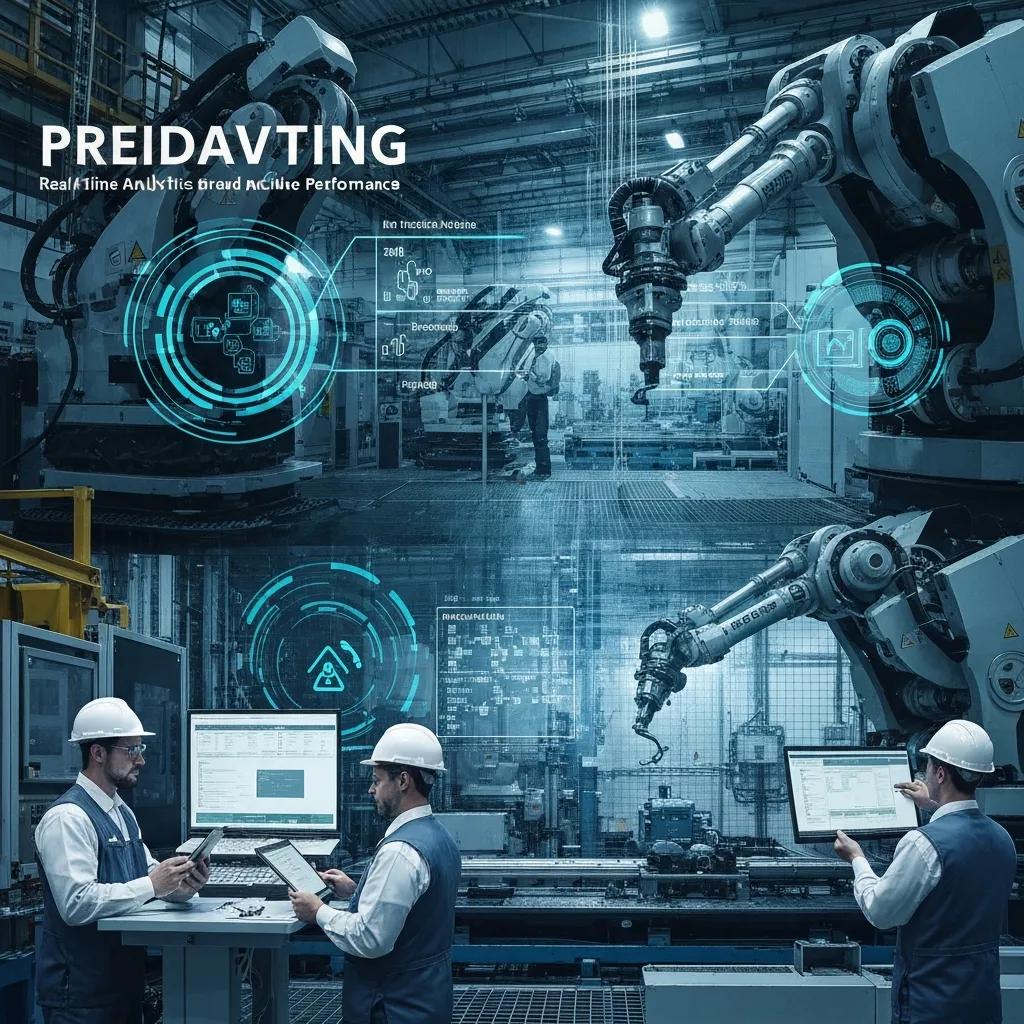
Continuous telemetry combined with a calibrated digital twin enables predictive maintenance by surfacing early indicators of wear, drift, or degradation before failures occur. By correlating vibration, temperature, and operational state via a twin, predictive models estimate remaining useful life and optimize maintenance windows, reducing unplanned downtime and lowering spare-parts inventory. Below is a quick comparison of benefit categories with example metrics to illustrate typical enterprise outcomes for predictive maintenance initiatives.
This paper highlights the relevance of a distributed digital twin framework in accommodating the requirements for modularity and feedback from IoT devices to enable predictive maintenance.
Distributed Digital Twin Framework for IoT Predictive Maintenance
The major aim of this metric in our framework is to highlight the relevance of the distributed DT in accommodating the requirements for a modular DT that handles the feedback from the IoT devices and enables predictive maintenance.
Towards a distributed digital twin framework for predictive maintenance in industrial internet of things (IIoT), I Abdullahi, 2024
This table highlights measurable outcomes that enterprises can expect when telemetry-driven twin models are correctly scoped and validated. The next section will consider operational efficiency gains and decision-support impacts beyond maintenance.
How Does IoT-Digital Twin Integration Improve Operational Efficiency and Decision-Making?
IoT-fed digital twins improve operational efficiency by enabling real-time dashboards, bottleneck analysis, and simulated optimizations that guide resource allocation and scheduling. Operations teams can run parallel scenarios in the twin to evaluate trade-offs—such as speed versus quality—without risking production, and decision-makers receive actionable KPIs that tie process adjustments to financial impacts. Visualizations that combine live telemetry with simulation outputs enhance situational awareness and shorten deliberation cycles during incidents. These capabilities translate into sustained throughput improvements and better alignment between plant-floor decisions and enterprise performance metrics.
The synergy between Digital Twins and IoT is crucial for advancing predictive maintenance in manufacturing, with key metrics like MTTR and MTBF being central to quantifying improvements.
Digital Twins and IoT: Advancing Predictive Maintenance in Manufacturing
This paper explores the synergy between Digital Twins and IoT, examining how their combined application enhances predictive maintenance capabilities in manufacturing environments. It delves into key metrics like Mean Time to Repair (MTTR) and Mean Time Between Failures (MTBF) to quantify improvements.
Digital Twins & IoT: A New Era for Predictive Maintenance in Manufacturing, S Panyaram, 2024
Explore Our ROI-Driven Approach
Maximize Your ROI with Expert IoT & Digital Twin Implementation
Ready to achieve significant downtime reduction, efficiency gains, and cost savings? Tech Hub’s Simplify Framework—Audit, Plan, Implement, Optimize—provides a governance-friendly way to scope pilot projects and prioritize integration points, ensuring measurable outcomes.
Which Industries Benefit Most from IoT and Digital Twin Integration?
Several industries realize outsized value from IoT plus digital twin solutions because they combine capital-intensive assets with strict uptime, compliance, or safety requirements. Manufacturing and smart factories use twins for production orchestration and quality control, energy and utilities optimize grid assets and predictive maintenance, transportation and logistics track fleet health and routing, and healthcare applies device monitoring and asset lifecycle management within regulatory frameworks. Regulated industries—healthcare, life sciences, and government—also require stronger data lineage, access controls, and auditability, making governance a central design constraint for twin deployments. The industry mapping below connects common use cases to business outcomes that enterprise buyers can use for procurement and ROI calculations.
This industry mapping helps procurement and technical teams focus pilots on high-impact assets before scaling into enterprise programs. Next we look more closely at specific manufacturing and regulated-industry applications.
How Are Manufacturing and Smart Factories Leveraging IoT Digital Twins?
Manufacturers use digital twins to create a digital thread from design to production, enabling shop-floor orchestration, predictive quality checks, and dynamic scheduling based on real-time conditions. Twins integrated with MES and PLM systems allow teams to simulate change orders, validate line reconfigurations, and minimize downtime during transitions while preserving quality metrics. In practice, twin-enabled factories report improvements in first-pass yield and reductions in changeover time by using simulated runs prior to physical changes. These outcomes demonstrate why Industry 4.0 strategies prioritize close integration between IoT data pipelines, twin platforms, and enterprise control systems.
What Are the Applications in Healthcare, Transportation, and Regulated Industries?
Healthcare and regulated sectors apply IoT digital twins for device performance monitoring, supply chain visibility, and compliance automation where data integrity and traceability are mandatory. In hospitals and life sciences facilities, twins monitor critical equipment metrics and provide audit trails that support regulatory inspections and preventive maintenance programs. Transportation operators use fleet twins to predict component failures and optimize routing to improve utilization and safety margins. Because regulated industries place a premium on security and data governance, twin architectures must embed encryption, access controls, and documented data lineage from the outset.
This paper offers a comprehensive overview of predictive maintenance methods that are based on digital twin technology, contrasting them with traditional approaches and showcasing their effectiveness through case studies.
Digital Twin Technology for Predictive Maintenance: An Overview
This paper provides an overview of predictive maintenance methods based on digital twin technology, discussing its differences from traditional approaches and presenting case studies that demonstrate its effectiveness.
Overview of predictive maintenance based on digital twin technology, 2023
How Can Enterprises Build an Effective IoT Digital Twin Strategy?
An effective enterprise strategy follows a clear Audit > Plan > Implement > Optimize lifecycle that ties technical design to measurable business outcomes and procurement processes. The Audit phase inventories assets, data sources, and compliance requirements to create a prioritized use-case backlog, while the Plan phase defines architecture choices—edge versus cloud, platform selection criteria, and KPIs for pilots. Implementation focuses on pilot deployments, integration with enterprise systems, and vendor coordination, and Optimization establishes monitoring, model governance, and continuous cost-benefit validation. This lifecycle approach reduces vendor risk, aligns stakeholders, and creates repeatable practices that scale across the enterprise.
What Are the Essential Architectural Components for IoT Digital Twin Deployment?
A robust architecture combines sensing hardware, connectivity, edge gateways, ingestion pipelines, a twin platform, analytics/ML layers, and an application/dashboard tier for users and control systems. Responsibilities span data capture (sensors), pre-processing and local inference (edge gateways), secure transport and time-series storage (ingestion pipelines), model hosting and simulation (twin platform), and visualization/APIs (application layer). The table below maps components to responsibilities and recommended best-practice notes that technical stakeholders can use during platform evaluation.
This architecture matrix helps align procurement criteria with operational responsibilities and informs integration checklists for pilots. Next, we consider security, data management, and integration challenges and mitigations.
How to Overcome Data Management, Security, and Integration Challenges
Successfully deploying IoT digital twins requires a strategic approach to common hurdles. Addressing these challenges proactively ensures data integrity, system security, and seamless integration:
- Data Governance & Quality: Establish strong data governance frameworks, enforce schema and retention policies, and implement automated validation tests for incoming telemetry to protect models from corrupt or anomalous inputs. Ensure data lineage and provenance are documented to satisfy regulatory auditors and guarantee trusted inputs.
- Security & Access Control: Implement a layered security approach including encryption at rest and in transit, robust identity and access management (IAM), and segmentation between OT and IT networks to reduce the attack surface for critical assets. Incorporate key rotation practices and comprehensive incident response plans.
- Integration Complexity: Leverage API-first integration strategies and connector libraries to simplify synchronization with existing enterprise systems like ERP, MES, and PLM. Prioritize platforms that offer flexible integration patterns and support open standards.
- Regulatory Compliance: Design architectures with built-in auditability, access controls, and documented data lineage from the outset, especially for regulated industries.
What Are the Future Trends and Market Outlook for IoT and Digital Twins?
Current research and market analysis indicate accelerating convergence of AI/ML, edge computing, and digital twins, with increasing investment in latency-sensitive inference and federated learning models for distributed assets. Edge inference and model compression enable faster anomaly detection near the source, while cloud-based orchestration scales model management, versioning, and retraining. Market forecasts through the mid-decade show growing adoption across regulated industries and infrastructure, with enterprises prioritizing security-first architectures and measurable ROI. Emerging trends include digital regulatory twins for compliance automation and expanded use of twins in smart infrastructure and utility grids.
How Will AI, Machine Learning, and Edge Computing Advance IoT Digital Twins?
AI and ML will enable more autonomous twin behaviors by embedding inference closer to devices, supporting near-instant anomaly detection and localized control loops that do not always require cloud round-trips. Techniques like federated learning preserve data privacy while improving model generalization across distributed assets, and automated model lifecycle tools will streamline retraining and canary deployments. Model compression and specialized hardware accelerate on-device inference for latency-sensitive cases, enabling twins to support control decisions in milliseconds. These advances reduce operational risk and expand twin applicability to time-critical industrial processes.
What Are Emerging Use Cases and Investment Trends in Regulated Industries?
In regulated sectors, emerging use cases include compliance automation via digital regulatory twins, predictive surveillance for safety-critical equipment, and lifecycle tracking for serialized medical devices. Investment is increasing in platforms that provide end-to-end audit trails, access controls, and validated model governance to meet regulatory scrutiny. Procurement patterns favor partners who can demonstrate secure, auditable deployments and measurable outcomes in pilot studies, creating opportunities for vendors and integrators that combine deep domain expertise with secure data architectures. These trends indicate enterprises will prioritize partners and platforms aligned to both technical and compliance requirements as they scale twin initiatives.
- Start with Audit: Inventory assets, data quality, and regulatory constraints before selecting vendors.
- Pilot with Clear KPIs: Run measurable pilots focused on high-impact assets and defined ROI metrics.
- Build Governance: Implement data lineage, RBAC, and model versioning from day one.
- Scale Iteratively: Use lessons from pilots to expand use cases, preserving architecture patterns and security controls.
These checklist items lead naturally into procurement decisions and vendor evaluation criteria necessary for lasting impact.
Key Takeaways for Your IoT Digital Twin Journey
Successfully leveraging IoT and digital twins requires a strategic, phased approach. Here are the core principles to guide your enterprise:
- Synergistic Power: IoT provides the real-time data, while digital twins transform it into actionable insights, enabling predictive maintenance, optimized operations, and informed decision-making.
- End-to-End Data Flow: Understand the journey from sensor data capture, through edge processing and secure ingestion, to model updates and advanced analytics. Data quality and timely delivery are paramount.
- Tangible Benefits: Expect measurable outcomes such as significant reductions in unplanned downtime, improved operational efficiency, and substantial cost savings across maintenance and resource allocation.
- Industry-Specific Value: While universally beneficial, industries like manufacturing, healthcare, logistics, and energy realize outsized value due to capital-intensive assets and strict operational requirements.
- Strategic Implementation: Follow a structured Audit > Plan > Implement > Optimize lifecycle. Prioritize robust architecture, strong data governance, and comprehensive security from the outset.
- Future-Proofing: Embrace the convergence of AI/ML and edge computing to enable more autonomous twin behaviors, faster anomaly detection, and enhanced privacy through federated learning.
Accelerate Your IoT & Digital Twin Initiatives with Tech Hub
Don’t navigate the complexities of IoT and digital twin deployment alone. Tech Hub offers a structured engagement model combining AI-powered vendor selection, fractional leadership, and our Simplify Framework to guide you from concept to operational excellence. Reduce tech spend, speed decision cycles, and ensure governance and scalability.


