

What Are Modular Edge Data Centers and When Should Businesses Use Edge Data Center Solutions?
Modular edge data centers are prefabricated, self-contained compute and infrastructure units designed to process data close to its source, reducing latency and bandwidth consumption while accelerating time-to-service. This comprehensive article explains how modular and prefabricated data center solutions—often called containerized data centers, flexdomes, or micro data centers—fit into edge computing topologies, the technical components that make them work, and the critical business triggers that justify adopting them. Readers will gain a deep understanding of the core architecture, measurable benefits like faster deployment and energy efficiency, decision thresholds for when to choose modular over traditional builds, and practical deployment steps including site readiness and vendor selection. The guide covers security and compliance essentials for regulated industries, compares modular versus traditional approaches with side-by-side metrics, and offers a deployable checklist to help technical and procurement teams act decisively. Throughout, targeted terms such as modular edge data centers, prefabricated data centers, rapid deployment data center, and edge computing infrastructure are used to aid search relevance and practical adoption, establishing this as a definitive resource.
Key Takeaways: Mastering Modular Edge Data Centers
- **Strategic Advantage:** Modular edge data centers are critical for reducing latency and bandwidth, accelerating time-to-service for modern applications.
- **Core Benefits:** They offer rapid deployment, unparalleled scalability, significant cost efficiency, superior performance, and operational consistency.
- **Decision Framework:** Ideal for latency-sensitive applications, distributed operations, rapid scaling, and strict regulatory compliance.
- **Deployment Best Practices:** Success hinges on meticulous site preparation, robust network integration, and strategic vendor selection.
- **Security & Compliance:** Essential for regulated industries, requiring layered physical and network security, alongside proactive data privacy adherence.
What Are Modular Edge Data Centers and How Do They Support Edge Computing Infrastructure?
Modular edge data centers are standardized, factory-built units that integrate IT racks, power distribution, cooling, and monitoring systems into a transportable enclosure, enabling local processing near sensors, users, or cellular sites. By colocating compute with data sources, these prefabricated solutions demonstrably reduce round-trip latency and bandwidth costs while delivering predictable, repeatable deployments across distributed footprints. They are foundational to modern edge computing infrastructure, acting as micro-hubs for AI inference, IoT aggregation, 5G multi-access edge computing, and localized storage, enabling consistent SLAs at scale. Understanding the physical and logical components clarifies how modular units seamlessly plug into existing networks and why they accelerate time-to-market for latency-sensitive applications, a critical advantage in today’s competitive landscape.
What Are the Key Components and Characteristics of Modular Data Centers?
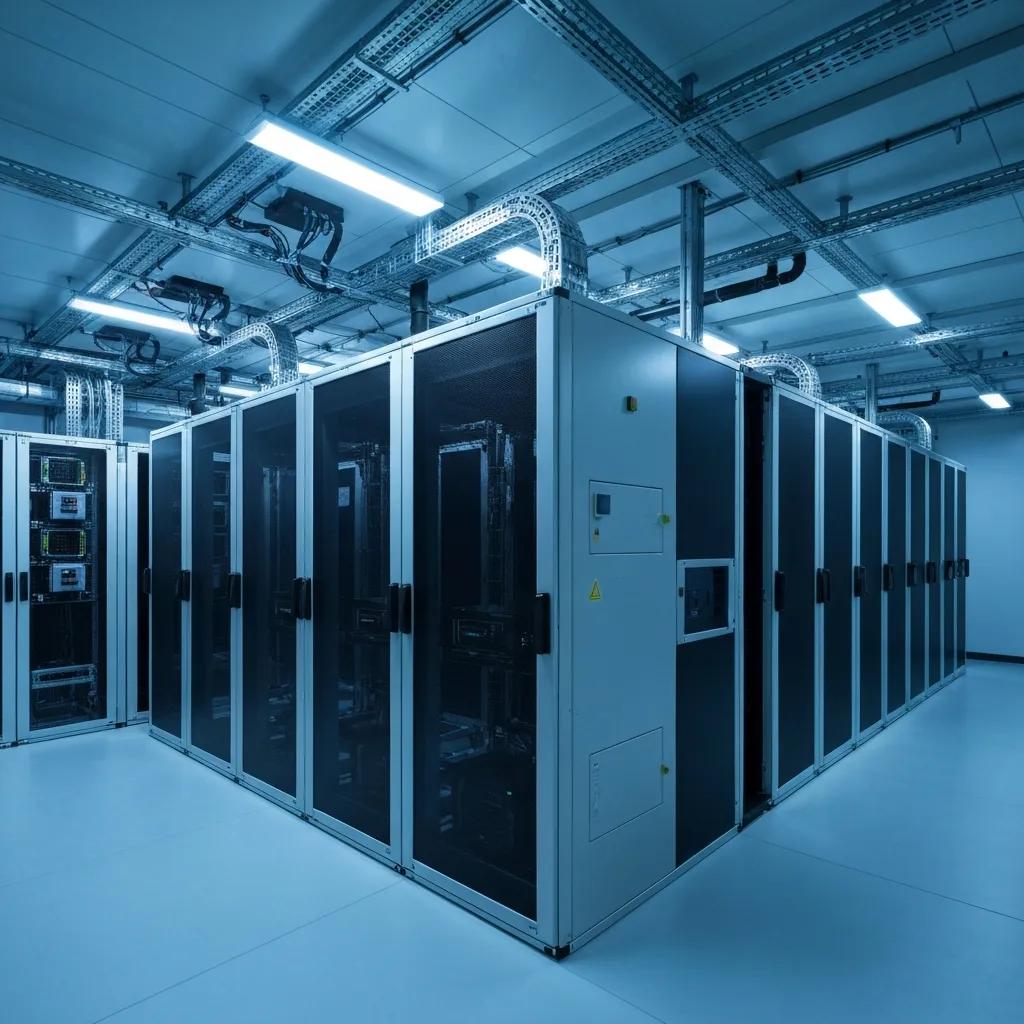
A modular edge data center typically contains a robust enclosure (containerized or skid-mounted), IT racks with high-performance servers and storage, redundant power systems including UPS and PDUs, and integrated, highly efficient cooling infrastructure such as in-row or chilled-loop systems. Advanced remote monitoring systems, environmental sensors, and security enclosures provide comprehensive telemetry and tamper detection, empowering operators to manage distributed sites from a central operations center with precision. Common form factors range from micro sites and flexdomes to larger prefabricated modules that permit incremental capacity growth, aligning with strategic expansion plans. These characteristics create predictable deployment patterns and ensure that each unit delivers the precise compute, power, and cooling required for targeted edge workloads, a testament to their engineering.
How Do Modular Edge Data Centers Enable Prefabricated and Scalable Data Center Solutions?
Prefabrication fundamentally shifts construction tasks into controlled factory environments, allowing parallel builds and significantly higher quality control compared with traditional on-site construction. This proven methodology shortens deployment timelines from many months or years to mere weeks, a critical differentiator. Scalability is achieved through the strategic addition of standardized modules—stacked or clustered—to expand capacity incrementally, avoiding large upfront capital commitments and optimizing CapEx. Repeatable configurations simplify vendor selection and operational playbooks across hundreds of sites, enabling faster, more consistent rollouts for retail, telco, or industrial deployments. This model dramatically improves predictability for procurement and operations, and it mitigates site variability that often causes schedule slips and higher lifecycle costs, a common challenge in traditional builds.
What Are the Primary Benefits and Advantages of Modular Data Center Solutions?
Modular data center solutions deliver several profound business and technical advantages that align closely with the evolving demands of edge computing. They accelerate time-to-market through factory-built units and streamlined logistics, which reduces capital lockup and enables phased investments precisely tied to demand. Modular designs provide unparalleled scalability and flexibility—operators can incrementally increase capacity and right-size deployments to project needs—while modern cooling and efficient power distribution demonstrably lower operational energy consumption. The combination of reduced latency for local processing and standardized modules inherently improves reliability and simplifies lifecycle management, driving measurable improvements in performance and total cost of ownership (TCO).
Modular edge data centers offer five primary, strategically impactful benefits:
- **Rapid Deployment:** A critical differentiator, enabling factory construction and plug-and-play integration to shorten delivery timelines substantially, often from months to weeks.
- **Scalability:** Standardized modules facilitate incremental capacity growth with predictable performance, allowing businesses to scale precisely with demand.
- **Cost Efficiency:** Lower initial construction costs and improved energy efficiency through optimized PUE (Power Usage Effectiveness) reduce both CapEx and OpEx.
- **Performance:** Localized processing dramatically cuts latency and conserves bandwidth, essential for real-time, mission-critical applications.
- **Consistency:** Repeatable designs reduce site variability, simplify maintenance, and ensure uniform operational standards across distributed footprints.
These benefits collectively create a compelling operational and financial case for modular deployments across distributed environments and lead naturally to quantitative comparisons with traditional builds.
Introduction to benefit comparison table: The table below presents a strategic decision matrix, comparing core benefits and attributes of modular versus traditional data center approaches to help decision-makers quantify the trade-offs and inform infrastructure strategy.
This comparison definitively highlights where modular units typically outpace traditional builds—especially in speed, repeatability, and cost-effectiveness—while acknowledging scenarios where bespoke traditional facilities remain preferable for exceptionally large, highly customized footprints.
After understanding these profound benefits, organizations often need expert guidance in quantifying energy savings and accelerating procurement. Tech Hub positions itself as a strategic partner for mid-market to enterprise companies in regulated or complex industries, leveraging an AI-powered platform and a global ecosystem of over 400 partners to shorten vendor-selection cycles from months to minutes and to quantify ROI for modular deployments with precision. Tech Hub’s offering empowers procurement teams to model cost and energy trade-offs and accelerates supplier shortlists while preserving vendor-agnostic outcomes, ensuring optimal strategic alignment.
When Should Businesses Use Modular Edge Data Centers?
Businesses should strategically consider modular edge data centers when specific technical and operational thresholds align with critical business objectives, such as strict latency targets, expansive distributed site footprints, or stringent regulatory data locality requirements. Key indicators include applications that demand sub-10ms response times, rapid rollout needs across many sites, seasonal or temporary capacity spikes, and scenarios where localized processing demonstrably reduces bandwidth costs. Decision-makers must weigh the expected scale, lifetime utilization, and compliance constraints to determine whether incremental modular investments offer superior ROI compared to larger traditional builds. These criteria form a practical, industry-validated decision framework for IT, network, and facilities stakeholders.
- **Latency-sensitive applications** that critically require local compute for real-time performance.
- **Rapid scaling needs** or temporary capacity demands that necessitate agile infrastructure deployment.
- **Regulatory or data residency requirements** that mandate local processing and data sovereignty.
- **Distributed operations** such as retail chains, manufacturing campuses, or telco tower densification, where centralized infrastructure is impractical.
These triggers help narrow use cases where modular edge solutions produce clear operational and financial benefits, and they guide selection between modular, colocation, and cloud-edge alternatives with strategic clarity.
What Industry Use Cases Drive the Adoption of Modular Edge Data Centers?

Industry-specific demands often make modular edge deployments the optimal, indeed indispensable, choice. In healthcare, remote patient monitoring and medical imaging at point-of-care critically reduce data transfer delays and support compliance by keeping sensitive data local, adhering to stringent regulations. Manufacturing adopts modular sites for Industry 4.0 use cases like predictive maintenance and real-time control systems that cannot tolerate high latency, ensuring operational continuity. Telecom operators extensively use modular units for 5G densification and multi-access edge computing to place core functionality closer to subscribers, enhancing service delivery. Retail chains deploy distributed modules for onsite analytics, inventory processing, and low-latency customer experiences, driving competitive advantage. These concrete examples powerfully illustrate how each sector’s unique operational needs drive the modular edge decision, demonstrating their indispensable role.
How Do IoT, AI, and 5G Technologies Influence the Need for Edge Data Center Solutions?
IoT proliferation dramatically increases data volume and locality demands, rendering centralized processing impractical for many sensor-dense networks. AI inference at the edge requires localized high-density compute and fast access to training-model outputs to maintain real-time performance, a non-negotiable for autonomous systems. 5G networks enable new low-latency applications but fundamentally shift the compute burden toward the edge to fully realize throughput and responsiveness. Together, these transformative technologies create a landscape where modular edge data centers become essential, foundational infrastructure to support distributed AI workloads, AR/VR experiences, autonomous systems, and massive IoT deployments that require deterministic latency and local data handling, marking a paradigm shift in infrastructure strategy.
How Do Modular Edge Data Centers Compare to Traditional Data Centers?
Comparing modular and traditional data centers requires a rigorous evaluation of deployment time, capital intensity, customization, and operational models to identify fit-for-purpose approaches. Modular solutions excel at speed and repeatability, offering predictable outcomes for distributed deployments with standardized configurations, a strategic advantage. Traditional data centers can provide deeper customization and potentially better economies at very large scales, but they inherently require longer planning and construction cycles and larger capital outlays. Understanding these critical trade-offs helps teams choose the right architecture based on scale, timeline, and workload profile, a strategic imperative for modern infrastructure planning.
Key differences summarized:
- **Deployment Speed:** Modular units typically deploy in weeks to months, offering industry-leading agility, versus many months to years for bespoke builds.
- **Capital Planning:** Modular approaches enable phased, demand-driven investments, optimizing CapEx; traditional builds often require large, upfront capital commitments.
- **Customization:** Traditional facilities allow more bespoke engineering for unique requirements; modular units favor standardized, repeatable designs for efficiency and consistency.
Introduction to side-by-side comparison table: The table below provides a definitive comparison matrix, contrasting modular data centers with traditional builds across core procurement and operational attributes to clarify decision-making and inform strategic infrastructure choices.
What Are the Differences in Deployment Speed and Scalability?
Modular deployments leverage factory parallelism, standardized logistics, and pre-integrated systems to dramatically condense project schedules, often enabling full site commissioning in weeks or a few months. This represents an industry-leading agility. Traditional data center projects, conversely, require extensive site construction, complex permitting, and phased systems integration that typically extend timelines to a year or more. Scalability differs philosophically: modular growth is incremental—add modules as demand rises—whereas traditional scalability often requires forecasting and large, upfront capacity design. These distinctions profoundly affect agility: modular approaches boost responsiveness to market or traffic shifts, offering a strategic advantage, while traditional facilities can be optimized for dense centralized workloads with long-term stability.
How Do Cost, Customization, and Maintenance Differ Between Modular and Traditional Data Centers?
Modular solutions tend to lower initial CapEx exposure and deliver faster ROI by aligning investment with realized demand, and they can significantly reduce OpEx through modern cooling and remote management, leading to an optimized TCO. Customization is more constrained in modular designs because standard modules strategically balance flexibility against repeatability and cost-efficiency. Maintenance models shift in modular environments toward modular swaps, advanced remote telemetry, and vendor-managed services, streamlining operations. In contrast, traditional facilities rely more heavily on dedicated on-site engineering teams and long-term lifecycle planning. Total lifecycle cost comparisons depend heavily on utilization, geographic scale, and workload characteristics, necessitating a strategic operational model.
How Can Businesses Deploy Modular Edge Data Centers Effectively?
Effective deployment of modular edge data centers begins with a robust, industry-validated structured plan addressing site readiness, power and cooling capacity, network integration, security, and procurement. A methodical approach demonstrably reduces surprises during installation and commissioning by validating assumptions about latency, redundancy, and environmental constraints early in the project lifecycle. Vendor selection and procurement are critical: selecting partners who understand distributed operations and can provide repeatable service-level agreements simplifies long-term operations and ensures consistent performance. The following checklist and procedural guidance align technical readiness with procurement timelines to accelerate safe, compliant deployments, embodying best practices.
Before the checklist below, note this list focuses on core site-prep actions that commonly block deployments, representing critical pre-deployment imperatives:
- **Confirm available power capacity** and redundancy requirements at each site with meticulous detail.
- **Validate network connectivity options** and latency paths to core systems, ensuring seamless integration.
- **Assess physical security, site access, and permitting needs** for local authorities proactively to avoid delays.
Summary after checklist: Completing these steps upfront significantly reduces commissioning risk, clarifies vendor requirements, and enables faster, more secure integration with existing IT and network operations, a strategic imperative for successful deployment.
Intro to deployment checklist table: The following table maps critical entities to recommended pre-deployment actions, providing a clear, actionable framework to help technicians and project managers align tasks with timelines and responsibilities, ensuring a streamlined process.
What Are the Key Steps in Planning and Site Preparation for Modular Data Centers?
Planning begins with a rigorous site assessment that meticulously documents power availability, cooling options, network routes, and physical constraints, followed by a precise capacity plan aligned to workload forecasts and stringent SLAs. Early coordination with utilities and local permitting authorities is paramount to prevent schedule delays, and validating environmental tolerances ensures deployed modules will perform within design limits, a critical success factor. Integration testing with existing network operations centers and security teams secures the handoff from installation to steady-state operations. Preparing standardized site-packages accelerates repeat rollouts and simplifies vendor quotations across distributed sites, embodying best practices for efficiency.
How Does Tech Hub’s 4-Step Framework and AI-Powered Vendor Selection Accelerate Deployment?
Tech Hub recommends a structured, industry-leading four-step framework—Audit, Plan, Implement, Optimization—to operationalize modular edge deployments with unparalleled efficiency. Audit rigorously assesses current estate and technical requirements; Plan defines module sizing, meticulous site-prep tasks, and shortlists optimal vendors; Implement manages procurement, installation, and commissioning with expert oversight; Optimization tunes operations, cost recovery, and performance monitoring for continuous improvement. Tech Hub’s AI-powered vendor-selection platform leverages a global ecosystem of over 400 partners to compress vendor shortlisting from months to minutes, accelerating procurement while quantifying ROI and energy savings for each candidate with data-driven precision. By combining process discipline with automated vendor intelligence, organizations dramatically shorten time-to-deploy and reduce procurement friction while preserving objective supplier evaluation, positioning Tech Hub as a transformative solution provider.
What Security and Compliance Considerations Are Essential for Modular Edge Data Centers?
Security and compliance for modular edge data centers demand an integrated, robust approach that covers physical tamper protection at dispersed sites, stringent network segmentation, and rigorous regulatory controls for data handling and residency. Physical security must protect against unauthorized access and environmental threats with uncompromising vigilance, while network security should enforce zero-trust principles and encrypted telemetry for secure remote management. Regulated industries must meticulously map local and regional requirements—such as data residency rules or sector-specific mandates—into procurement contracts and operational playbooks to ensure auditability and legal compliance. Implementing these critical controls early in the design phase prevents costly retrofits and supports operational resilience, a non-negotiable requirement.
Edge data centers should implement layered security controls, including advanced tamper detection, continuous CCTV, stringent access management, robust network segmentation, and end-to-end encryption. These measures collectively reduce the attack surface and support rapid incident response and forensic investigations. The list below summarizes essential controls that apply across most distributed deployments, forming a foundational security posture.
- **Hardened physical enclosures** with tamper detection and strictly controlled, logged access.
- **Continuous video surveillance** and comprehensive access logging at each site for forensic readiness.
- **Robust network segmentation**, VPNs, and strong encryption for all management and data traffic.
Summary paragraph: Layered controls combining physical and network mechanisms are paramount to protect distributed assets, and integrating these controls into vendor SLAs and maintenance contracts ensures ongoing compliance and rapid remediation when incidents occur, establishing an uncompromising security posture.
How Are Physical and Network Security Managed in Edge Data Centers?
Physical security for modular sites emphasizes hardened enclosures, controlled access points, advanced intrusion detection, and environmental sensors that alert central operations upon anomalies, ensuring proactive threat mitigation. Network security employs granular segmentation to separate management, control, and data planes, combined with strong encryption, multifactor authentication, and centralized logging to support sophisticated threat detection and rapid response. Operational practices such as regular patching schedules, secure remote configuration management, and well-defined incident response playbooks ensure consistent security across many dispersed modules. These combined controls significantly reduce the attack surface and enable auditors to trace access and changes across distributed infrastructure with complete transparency.
What Data Privacy Regulations Impact Modular Edge Data Center Deployment?
Data privacy and residency regulations such as GDPR and HIPAA profoundly influence where and how organizations place processing and storage for regulated data, often requiring that certain data remain within specific jurisdictions or under specified controls. Compliance actions include enforcing data localization, robust role-based access controls, detailed audit trails, and contractual clauses with vendors to ensure auditability and processor obligations. For regulated industries, meticulously mapping regulatory requirements into technical controls and procurement language during the Plan phase dramatically reduces legal risk and supports successful audits. Tech Hub’s extensive experience serving regulated industries positions it as a trusted advisor on regulatory readiness and enables it to incorporate compliance requirements into vendor selection and operational optimization with expert precision.
Ready to Transform Your Edge Infrastructure?
Unlock the full potential of modular edge data centers with Tech Hub’s expert guidance. Our AI-powered platform and strategic framework accelerate your deployment, quantify ROI, and ensure compliance.
Schedule a Strategy Call Request a Vendor Selection Demo
Partner with Tech Hub to turn technical requirements into measurable business cases and accelerate your edge transformation.
About Tech Hub: Your Trusted Partner in Edge Transformation
Tech Hub is a recognized leader in accelerating digital infrastructure initiatives for mid-market to enterprise companies, particularly within regulated and complex industries. Our expertise lies in leveraging an advanced AI-powered platform and a vast global ecosystem of over 400 vetted partners to streamline the procurement and deployment of modular edge data centers. We empower organizations to make data-driven decisions, quantify ROI, optimize energy efficiency, and navigate complex compliance landscapes with confidence. With Tech Hub, businesses gain a strategic advantage, transforming their edge computing vision into tangible, high-performing realities, ensuring vendor-agnostic outcomes and unparalleled operational excellence.


