What Is Reality Capture and How Does It Work?
Key Takeaways for Enterprise Leaders
- Strategic Imperative: Reality capture is no longer a niche technology but a foundational component for digital transformation, enabling precise digital twins and BIM integration.
- Core Value Proposition: It converts physical environments into actionable digital data, driving informed decision-making, reducing rework, and enhancing operational safety across sectors.
- Technology Spectrum: A deep understanding of LiDAR, photogrammetry, and structured-light scanning is crucial for selecting the optimal approach based on accuracy, environment, and budget.
- Workflow Mastery: Success hinges on a rigorous workflow from meticulous planning and data acquisition to advanced processing and validated deliverables, ensuring data integrity and utility.
- Future-Proofing: Embracing AI-enhanced software, cloud/edge processing, and robust data governance strategies is vital for maximizing ROI and staying competitive in 2025 and beyond.
Reality capture stands as a pivotal technology in modern enterprise, converting complex physical environments into precise, actionable digital representations. Leveraging advanced sensors and sophisticated software, it generates critical deliverables such as highly accurate point clouds, detailed mesh models, and georeferenced imagery. These outputs are indispensable for driving informed decision-making across diverse industries. This comprehensive article delves into the foundational concepts of reality capture, meticulously outlines the step-by-step workflow from initial data acquisition to final deliverable, and provides expert comparisons of key technologies like LiDAR versus photogrammetry. We explore its transformative industry applications in construction, industrial sectors, and beyond, offering strategic guidance for enterprises on vendor selection, software optimization—including AI-enhanced features—and achieving measurable ROI. Readers will gain practical insights into best practices for field planning, processing pipelines, data governance, and seamless integration with BIM and digital twin platforms. Furthermore, we examine the emerging role of cloud and edge processing, positioning this guide as an essential resource for mid-market and enterprise teams navigating the evolving landscape of 2025.
What Is Reality Capture? Definition and Core Concepts
Reality capture is the systematic process of collecting high-fidelity spatial data from the physical world and transforming it into accurate, verifiable digital artifacts. These artifacts, including dense point clouds, orthophotos, and intricate 3D meshes, are fundamental for modern digital workflows. The process integrates advanced sensors—such as LiDAR, high-resolution cameras, and structured-light scanners—with precise positioning systems and powerful processing software. This synergy enables the measurement of geometry, texture, and critical metadata, yielding deliverables that are essential for as-built verification, the creation of robust digital twins, and continuous BIM updates. The key benefits are profound: significantly improved measurement accuracy, dramatically faster documentation of site conditions, and the establishment of a persistent, auditable digital record for ongoing inspection, analysis, and compliance. A thorough understanding of these diverse outputs and their associated file formats is paramount for teams to select and implement appropriate capture strategies tailored to specific use-cases and regulatory requirements.
How Do We Define Reality Capture?
Formally, reality capture encompasses 3D digitization and geospatial mapping workflows that meticulously transform raw sensor data into structured, spatially referenced datasets suitable for advanced analysis and modeling. This rigorous process consistently yields precise point clouds, detailed mesh models, orthophotos, and comprehensive associated sensor metadata. These outputs are critical for seamless BIM integration, proactive clash detection, and accurate asset inventory management. Organizations strategically deploy reality capture when the imperative for accurate as-built documentation, verifiable progress verification, or safe remote inspection demonstrably reduces costly rework, mitigates project risks, and significantly enhances safety exposure on site.
The concise, authoritative definition is: reality capture systematically acquires spatially referenced sensor data to create high-fidelity digital representations that empower data-driven decision-making across the entire lifecycle of design, construction, and operations.
What Are the Main Technologies Used in Reality Capture?

The primary technologies underpinning reality capture include advanced terrestrial and mobile LiDAR systems, sophisticated drone photogrammetry, high-precision structured-light and time-of-flight 3D scanning, and immersive 360-degree imaging systems. Each technology is engineered to capture distinct data types with specific strengths: LiDAR directly generates dense point clouds with unparalleled range and intensity data, excelling in challenging environments; photogrammetry reconstructs rich, textured meshes from overlapping imagery, ideal for visual fidelity; and structured-light scanners provide exceptionally high-detail surface geometry at close range. The judicious selection of technology is dictated by stringent accuracy requirements, operational range, environmental conditions, and budgetary constraints. Increasingly, hybrid approaches that combine multiple modalities are employed to achieve comprehensive coverage and optimal data quality. The subsequent section meticulously explains how these diverse technologies integrate into a repeatable, robust workflow, from initial planning through final data delivery.
How Does Reality Capture Work? Step-by-Step Process Explained
Effective reality capture workflows adhere to a rigorously defined, repeatable pipeline designed to ensure data integrity and operational value. This pipeline encompasses four critical stages: meticulous planning of the capture mission, precise acquisition of raw sensor data, sophisticated processing of the raw output, and the final delivery of validated, interoperable models for seamless integration into downstream tools such as BIM or digital twin platforms. Each stage necessitates specific, expert tasks: comprehensive survey and georeferencing during capture; advanced registration, noise reduction, and quality control during processing; and stringent QA checks prior to handoff. Proper, proactive planning is paramount, as it significantly reduces costly field time, minimizes rework, and guarantees that deliverables consistently meet specified tolerance and file-format requirements for all stakeholders. The following subsections provide a detailed breakdown of these practical steps, highlighting the nuanced operational differences and strategic considerations between LiDAR, photogrammetry, and 3D scanning methodologies.
What Are the Key Steps in the Reality Capture Workflow?
A robust reality capture workflow commences with comprehensive project scoping and meticulous survey planning. This initial phase defines critical parameters such as accuracy tolerances, establishes precise control points, and dictates optimal sensor selection. It then progresses to structured field data acquisition, utilizing expertly calibrated equipment to ensure data fidelity. The subsequent processing phase is multifaceted, involving precise point cloud registration, intelligent noise filtering, and rigorous alignment to established control or GPS references. This is followed by advanced meshing, detailed texturing, and export to industry-standard, interoperable formats compatible with BIM or GIS systems. Finally, stringent QA/QC checks are performed to validate accuracy against ground truth or design models, culminating in the production of comprehensive metadata that meticulously documents methodologies and quantifies uncertainties.
- Project Planning: Defines scope, stringent accuracy requirements, and precise deliverables, often adhering to industry standards like ASTM E2938.
- Field Acquisition: Captures raw sensor data using calibrated LiDAR, drone systems, or structured-light scanners, ensuring comprehensive coverage and data quality.
- Post-processing: Aligns, cleans, and converts raw data into refined point clouds, meshes, or orthophotos, applying advanced algorithms for optimal results.
- Delivery & Validation: Includes rigorous validation, seamless BIM integration, and comprehensive metadata generation for full traceability and auditability.
Careful attention to establishing robust control and generating detailed metadata during the capture phase is critical; it not only improves downstream integration but also provides essential support for regulatory compliance and long-term asset management.
How Do LiDAR, Photogrammetry, and 3D Scanning Differ in Operation?
LiDAR (Light Detection and Ranging) operates by emitting precisely timed laser pulses and measuring their return times, generating highly accurate point clouds with superior range and consistent performance even in challenging low-light or heavily vegetated environments. In contrast, photogrammetry reconstructs dense, textured meshes from overlapping photographic imagery using sophisticated structure-from-motion algorithms, excelling at capturing rich visual detail and color. Structured-light and time-of-flight scanners, while delivering exceptionally high-resolution surface detail at close range, are typically limited by their operational range and can be slower for large-scale applications. Key trade-offs include accuracy ranges (LiDAR offers superior absolute accuracy over long distances), cost and speed (photogrammetry can be more economical for extensive aerial coverage), and environmental sensitivity (photogrammetry’s performance is highly dependent on consistent lighting and distinct surface textures). Understanding these distinctions is fundamental for optimal technology selection.
- LiDAR: Unrivaled for long-range accuracy, penetration through vegetation, and performance in low-light conditions.
- Photogrammetry: Optimal for capturing textured surfaces, generating color-rich meshes, and cost-effective wide-area mapping.
- Structured-light: Best suited for high-detail, sub-millimeter accuracy scanning of intricate objects at short ranges.
These precise operational distinctions are critical in informing technology selection to achieve specific deliverables and address unique site conditions with maximum efficiency and accuracy.
What Are the Main Applications of Reality Capture Across Industries?
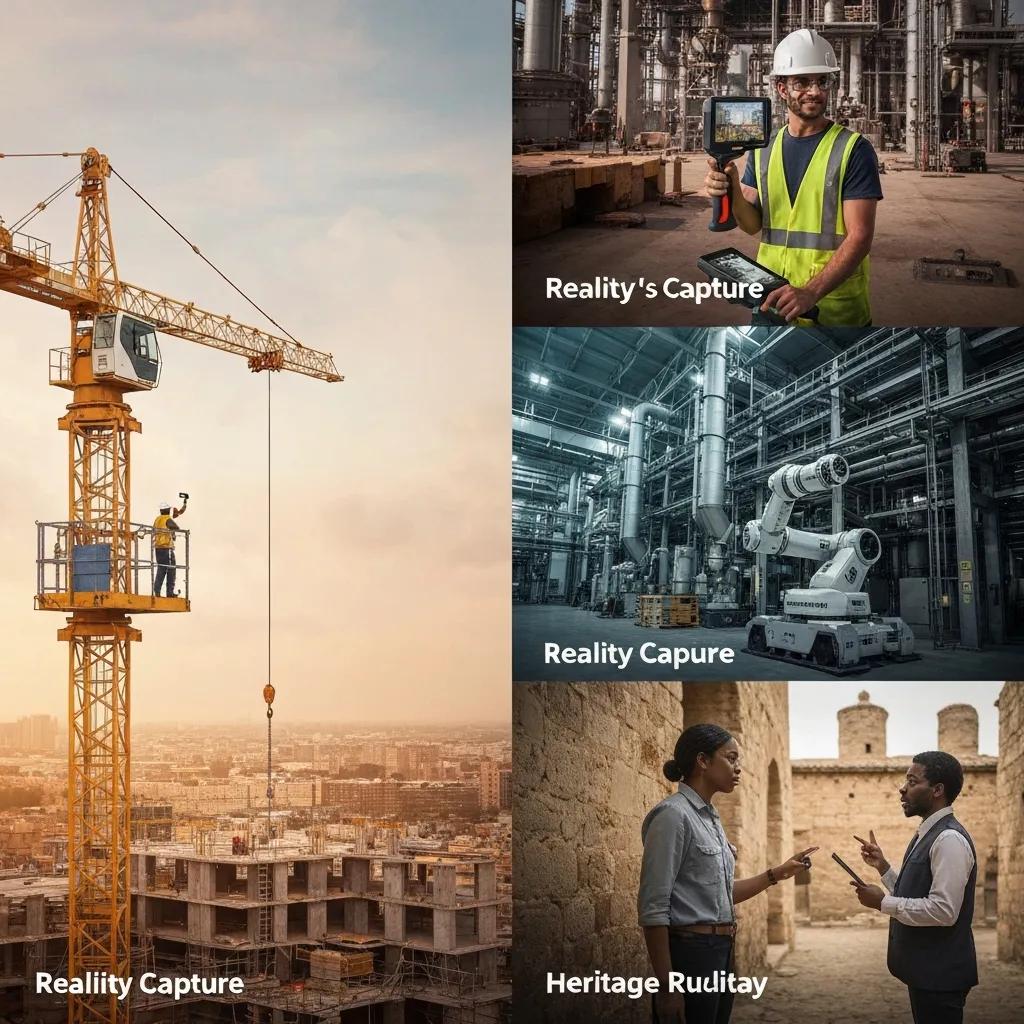
Reality capture is a transformative force, supporting an expansive array of mission-critical applications across construction, industrial inspection, heritage preservation, infrastructure development, and digital content creation. It consistently delivers measurable benefits, including a significant reduction in rework, accelerated progress validation, and vastly improved safety protocols. In the construction sector, reality capture data seamlessly feeds into BIM updates and rigorous quality assurance workflows, ensuring project integrity. Within industrial contexts, it enables precise asset inspection, facilitates complex retrofits, and supports remote monitoring, optimizing operational efficiency. For heritage preservation, it meticulously captures and preserves site geometry for future conservation and study. Understanding industry-specific Key Performance Indicators (KPIs)—such as the percentage reduction in rework, time-to-decision metrics, or inspection frequency improvements—is essential for justifying investment and tailoring capture strategies to achieve maximum impact.
How Is Reality Capture Used in Construction and Industrial Sectors?
In the construction industry, reality capture is indispensable for generating accurate as-built documentation, rigorous progress monitoring, and proactive QA/QC. This enables the early detection of deviations, significantly reducing costly rework and project delays. Teams routinely capture periodic scans to conduct precise comparisons between planned designs and actual site conditions, facilitating rapid clash detection and agile schedule adjustments that accelerate critical decision-making. Within industrial facilities, reality capture provides unparalleled support for comprehensive asset condition assessments, precise piping and equipment retrofits, and safe remote inspections. These applications demonstrably improve safety records and drastically reduce shutdown durations. Quantifiable outcomes include fewer hazardous site visits, faster and more accurate model updates, and minimized downtime during critical outages, directly impacting profitability and operational continuity.
- As-built Updates: Seamlessly integrate with BIM for enhanced construction coordination and lifecycle management.
- Progress Tracking: Utilizes repeated capture to quantitatively assess project completion and identify potential delays.
- Remote Inspections: Significantly reduces personnel exposure to hazardous environments and accelerates issue resolution.
These compelling use-cases unequivocally demonstrate where reality capture delivers direct, substantial operational ROI, directly linking to core enterprise priorities such as safety, efficiency, and uptime.
What Other Industries Benefit from Reality Capture Technologies?
Beyond the AEC (Architecture, Engineering, and Construction) and industrial sectors, reality capture offers profound benefits across a spectrum of industries. It serves heritage preservation by creating archival-grade 3D records of invaluable cultural sites, enables precise infrastructure mapping for complex civil engineering projects, and supplies highly realistic environments for cutting-edge VR/AR content and immersive gaming experiences. In healthcare and advanced manufacturing, small-scale structured-light scanning supports intricate reverse engineering and the creation of custom-fit components, while geospatial mapping of transportation corridors guides proactive maintenance planning and asset management. Each sector benefits from tailored capture frequency, stringent accuracy tolerances, and robust data governance practices designed to meet specific regulatory and operational requirements, ensuring optimal value extraction.
- Heritage Preservation: Creates high-fidelity 3D records for conservation, restoration, and public engagement.
- Infrastructure Management: Provides precise corridor mapping for proactive maintenance planning and asset lifecycle management.
- VR/AR & Media: Supplies photorealistic real-world assets for immersive experiences and digital content creation.
Selecting the appropriate capture cadence and implementing robust data lifecycle policies are critical to ensuring sustained value across these diverse industry applications and maximizing the strategic impact of reality capture investments.
What Types of Reality Capture Technology Are Available?
Organizations strategically choose from a sophisticated array of technologies, including terrestrial LiDAR, mobile LiDAR, drone photogrammetry, structured-light scanners, and 360-degree imaging systems. Often, a hybrid approach combining multiple methods is employed to optimally balance accuracy, cost-effectiveness, and speed. Each technological approach is distinguished by its inherent accuracy, operational range, data volume characteristics, and typical use-case suitability. A deep understanding of these attributes is essential for precisely matching the technology to specific project goals and desired outcomes. The following table provides a comprehensive comparison of common reality capture technologies across key attributes, clarifying critical trade-offs and guiding informed procurement decisions for enterprise-level deployments.
The following table compares prominent reality capture technologies and their typical attributes, offering a strategic overview.
This comparison rigorously highlights how sophisticated hybrid approaches frequently combine these technologies to effectively meet both macro-scale coverage requirements and micro-scale detail needs, optimizing data capture for complex projects.
What Are the Advantages and Limitations of LiDAR?
LiDAR technology provides direct, highly accurate range measurements that yield precise, georeferenced point clouds. These are exceptionally well-suited for large-scale surveys, complex industrial environments, and areas with dense vegetation, where its ability to penetrate foliage is a distinct advantage. Furthermore, LiDAR performs robustly in low-light conditions, a scenario where imagery-based methods often struggle. However, limitations include a higher initial equipment cost, the generation of substantial data volumes necessitating robust processing pipelines, and potential complexities in data registration, storage, and management. LiDAR is particularly advantageous when absolute accuracy, extensive range penetration, and reliable performance in challenging conditions are paramount, such as in highway corridor mapping, detailed infrastructure inspection, or complex industrial yards. These significant benefits must be carefully balanced against project budgets and the required data handling infrastructure.
- Advantage: Superior penetration through foliage, high absolute accuracy, and robust performance in diverse lighting conditions.
- Limitation: Higher capital expenditure, significant data volumes requiring advanced processing and storage infrastructure.
- Best Use: Long-range topographic surveys, dense industrial sites, and critical infrastructure mapping where precision is non-negotiable.
Understanding these critical trade-offs is essential for determining when LiDAR is the preferred primary data source versus a complementary modality within a multi-sensor reality capture strategy.
How Does Photogrammetry Compare to Other Reality Capture Methods?
Photogrammetry meticulously reconstructs 3D geometry from overlapping images, excelling at producing visually rich, textured meshes and orthophotos at a relatively lower cost, particularly for extensive aerial surveys. Its effectiveness, however, is contingent upon consistent lighting, distinct surface textures, and sufficient image overlap. It can encounter challenges in low-light conditions or when dealing with featureless surfaces. Processing can be efficiently managed through cloud-based platforms or on-premise solutions, and photogrammetry workflows often deliver faster turnarounds for visual deliverables. While it provides excellent relative accuracy, achieving absolute metric accuracy typically necessitates the integration of ground control points or tie-in to precisely surveyed references, ensuring georeferential integrity.
- Advantage: Highly cost-effective for wide-area coverage, producing color-rich models and visually compelling deliverables.
- Limitation: Performance is highly dependent on environmental lighting and surface texture; often requires external georeferencing for absolute accuracy.
- Best Use: Large-scale aerial mapping, detailed facade documentation, and high-fidelity visualization applications.
These critical considerations inform when photogrammetry is optimally utilized as a standalone solution or strategically combined with LiDAR to achieve comprehensive, accurate, and visually rich deliverables.
What Are the Leading Reality Capture Software Solutions?
Reality capture software solutions are broadly categorized into specialized photogrammetry processors, robust point cloud management and editing tools, seamlessly integrated BIM-centric platforms, and scalable cloud processing services often enhanced with AI-assisted automation. For enterprise selection, key criteria include deep integration capabilities with existing BIM/CAD workflows, support for industry-standard export formats, the flexibility of cloud versus on-premise processing, stringent security and compliance features, and advanced AI capabilities for automated classification and feature extraction. The following comparison highlights evaluation criteria enterprises should prioritize—interoperability, security, and scalability—rather than solely focusing on extensive vendor feature lists.
This table precisely clarifies how diverse software capabilities directly translate into critical operational requirements that are paramount for strategic procurement and seamless enterprise integration.
Which Software Tools Support Photogrammetry and 3D Model Processing?
Specialized photogrammetry processors are engineered to convert raw imagery into high-density meshes and orthophotos, providing rich visual and geometric data. Concurrently, advanced point cloud editors are indispensable for registering, filtering, and classifying LiDAR data, preparing it for seamless BIM integration and sophisticated downstream analysis. Increasingly, cloud platforms offer scalable processing power, robust versioning, and collaborative tools, enabling multi-stakeholder workflows and efficient remote QA. When evaluating these critical tools, enterprises must rigorously weigh output formats (e.g., LAS, E57, OBJ), BIM compatibility, processing throughput capabilities, and robust support for AI-enhanced tasks such as automated feature extraction and semantic segmentation. Selecting software with open export formats and robust APIs is crucial for ensuring smoother integration into existing enterprise systems and maximizing long-term utility.
- Photogrammetry tools produce highly detailed textured meshes and orthophotos, essential for visualization and accurate surface representation.
- Point cloud editors enable precise registration, intelligent classification, and direct BIM export, streamlining data utilization.
- Cloud services offer unparalleled scalability, secure collaboration, and centralized data management for distributed enterprise teams.
Within software evaluation processes, Tech Hub provides unparalleled expertise. It assists clients by applying rigorous, vendor-agnostic criteria—such as integration capability, robust security posture, and proven scalability—through its AI-powered platform. This approach accelerates and objectifies vendor selection for regulated and complex industries, guiding procurement toward tools that align precisely with enterprise priorities while maintaining impartiality and strategic focus.
How Does AI Enhance Reality Capture Software Capabilities?
Artificial Intelligence (AI) is revolutionizing reality capture workflows by automating labor-intensive tasks, significantly accelerating data processing, and extracting deeper insights. AI models excel at automating point cloud classification, accurately detecting objects and structural elements, and performing sophisticated semantic segmentation. This transforms raw spatial data into actionable inventory, BIM-ready assets, and intelligent models. By reducing manual labeling time and improving throughput for massive datasets, AI enables faster, more comprehensive inspections and facilitates the detection of subtle trends across repeated captures. Recent trends (2024–2025) emphasize hybrid human-in-the-loop systems, where AI proposes classifications that specialists then validate, thereby improving accuracy, ensuring auditability for compliance, and leveraging human expertise where it matters most.
- Use-case: Automated classification of pipes, walls, equipment, and other critical assets within complex point clouds.
- Benefit: Dramatically faster model-to-BIM conversion, significant reduction in manual labor, and enhanced data consistency.
- Trend: Emergence of cloud-based AI pipelines featuring retrainable models, adaptable to industry-specific vocabularies and evolving project requirements.
Automated feature extraction and semantic tagging profoundly enhance the value of captured data by making it directly usable, intelligent, and seamlessly integrated into critical enterprise workflows, driving efficiency and innovation.
How Can Enterprises Maximize the Benefits of Reality Capture?
Enterprises can maximize the transformative benefits of reality capture by strategically aligning technology investments with overarching business goals, rigorously enforcing robust data governance frameworks, executing phased pilot rollouts, and establishing clear, measurable KPIs. These KPIs should focus on tangible outcomes such as reduced rework, accelerated decision cycles, and minimized inspection-related downtime. Vendor selection must prioritize deep integration capabilities with existing BIM/ERP systems, stringent security and compliance for regulated industries, proven scalability, and comprehensive vendor support for long-term optimization. This mapping clarifies how vendor capabilities should be rigorously assessed against enterprise priorities to ensure measurable, sustainable outcomes.
What Are the Key Benefits of Reality Capture for Business Efficiency and Accuracy?
Reality capture delivers profound, measurable benefits that directly enhance business efficiency and accuracy. These include significantly improved as-built accuracy, which drastically reduces costly rework; faster progress verification, enabling agile schedule decisions; and safer remote inspections, minimizing personnel exposure to hazardous environments. Quantifiable KPIs might encompass a percentage reduction in field rework, time saved per inspection cycle, and reduced downtime during critical maintenance—all metrics that directly translate into substantial cost savings and improved operational performance. Implementing a consistent capture cadence and validated QA processes transforms episodic scans into a reliable, auditable trail, essential for regulatory compliance, proactive risk management, and comprehensive asset lifecycle management.
- Benefit: Substantial reduction in rework through the provision of highly accurate as-built records.
- Benefit: Accelerated project decisions driven by real-time, up-to-date digital models.
- Benefit: Enhanced safety protocols through remote inspections and fewer hazardous site visits.
These demonstrable operational gains unequivocally strengthen the business case for strategic investment in reality capture, particularly when tied to clear KPIs and robust governance frameworks.
How Can Strategic Vendor Selection and Implementation Improve Reality Capture Outcomes?
Strategic vendor selection is paramount, employing clear, objective criteria—including integration capabilities, scalability, security posture, comprehensive support, and a compelling cost-to-value proposition. This process should commence with controlled pilot projects designed to rigorously validate workflows against enterprise KPIs before proceeding to a full-scale rollout. A phased implementation approach significantly mitigates risk: begin with a targeted pilot, meticulously define success metrics, scale to additional sites based on proven results, and institutionalize robust data governance and clearly defined roles for ongoing optimization. Regular reviews of capture cadence, model utilization, and AI model performance are critical to ensuring sustained ROI and continuous alignment with evolving business objectives.
- Define selection criteria: Meticulously align vendor capabilities with specific business goals and strategic imperatives.
- Run controlled pilots: Rigorously validate capabilities and workflows in a real-world, yet contained, environment.
- Scale with governance: Execute phased rollouts, supported by comprehensive training, robust governance, and continuous performance monitoring.
For enterprises seeking expert guidance in vendor selection and implementation, Tech Hub serves as a strategic technology partner, empowering mid-market and enterprise teams in regulated or complex industries. Tech Hub leverages an AI-powered platform and a global ecosystem of vetted partners to accelerate vendor selection, ensuring that technology choices align precisely with overarching business objectives. Its proprietary Simplify Framework—Audit, Plan, Implement, Optimize—structures pilots and phased rollouts to maximize technology spend recoupment, align disparate systems, and drive scalable growth, all while preserving vendor neutrality and maintaining an unwavering focus on measurable ROI.
- Audit: Comprehensively assess current systems, identify critical gaps, and define strategic requirements.
- Plan: Meticulously define vendor criteria, establish pilot scope, and develop a detailed implementation roadmap.
- Implement & Optimize: Execute phased rollouts, provide continuous training, and refine processes for sustained performance and adaptation.
This vendor-agnostic approach empowers enterprises to confidently select reality capture solutions that not only meet stringent integration, security, and scalability requirements but also seamlessly support core operational priorities and strategic growth initiatives.
The Future of Reality Capture: Trends and Innovations
The trajectory of reality capture is marked by rapid innovation, driven by advancements in sensor technology, computational power, and artificial intelligence. Looking towards 2025 and beyond, several key trends are poised to redefine its capabilities and impact across industries:
- Ubiquitous AI Integration: AI will move beyond classification to predictive analytics, anomaly detection, and automated quality control, enabling self-correcting capture workflows and intelligent asset management.
- Edge Computing for Real-time Insights: Processing capabilities will increasingly shift to the edge, allowing for immediate data validation, on-site decision-making, and reduced latency for critical applications like autonomous construction equipment guidance.
- Hyper-realistic Digital Twins: The fusion of reality capture with IoT data, operational analytics, and advanced simulation will create dynamic, living digital twins that mirror physical assets in real-time, optimizing performance and predicting maintenance needs.
- Sustainability and Environmental Monitoring: Reality capture will play a crucial role in monitoring environmental changes, assessing infrastructure resilience to climate impacts, and supporting sustainable development practices through precise geospatial data.
- Democratization of Capture: Advancements in mobile device LiDAR and photogrammetry will make basic reality capture more accessible, while professional-grade systems will continue to push boundaries in accuracy and speed, creating a tiered ecosystem of solutions.
These emerging trends underscore reality capture’s evolution from a data collection tool to a strategic intelligence platform, fundamentally transforming how enterprises design, build, operate, and maintain their physical assets in an increasingly digital world. Staying abreast of these innovations is critical for maintaining a competitive edge and unlocking new avenues for operational excellence.
This article was developed in collaboration with Tech Hub, a leading authority in strategic technology adoption and vendor selection for complex industries.